Friday, November 12, 2010

The Games Book: How to Play the Games of Yesterday

Author: Huw Davies
ISBN: 054513403X
Publisher: Scholastic, Inc., 2009
Age: 9-12
Genre: Non-fiction

Summary: This terrific compilation includes instructions for traditional indoor and outdoor games that have been favorites for generations of children and their parents before them.  Of the games included in this book are classics like jacks, marbles, hopscotch, capture the flag, and hide-and-seek.  Also included are instructions for card games such as rummy, solitaire, slapjack, and more. 

Read A-likes: How to Sew a Button: And Other Nifty Things Your Grandmother Knew.

Personal Thoughts: This book is a fabulous book for anyone who has children or works with children.  A great way to interest kids in classic games that require physical and brain activity and minimizes time in front of the TV and other digital distractions.  Some of the games are old familiar favorites and others are new ones to learn to add to a game repertoire.   

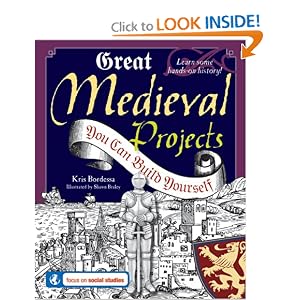
Great Medieval Projects You Can Build Yourself

Author: Kris Bordessa
ISBN: 0979226805
Publisher: Nomad Press, 2008
Age: 9-12
Genre: Non-fiction

Summary: Within the pages of Great Medieval Projects the reader gets to immerse themselves in everything medieval.  From the history of the making of medieval Europe, to information about the kings and queens, knights and their armor, warfare, castles, villages, homes, cities and towns, beliefs, and even feasts, this book is a trip back in time.  Also included are numerous projects for the reader to complete such as creating your own heraldic shield, building a trebuchet, a marshmallow cannon, a jester hat, juggling sticks, and even chain mail.  There are also several recipes to make foods from the medieval time including almond milk, butter, potage, trenchers, pokerounce, and even insect repellant.  You learn about the hygiene and even the medical procedures of the day.  Fascinating from the first page!

Read A-likes: Great Civil War Projects; Great World War II Projects; Amazing Kitchen Chemistry Projects; Great Colonial America Projects; and so many more!

Personal Thoughts: This book is not only a fabulous book for kids, young boys especially, but it also would be a helpful classroom tool for history and social studies lessons.  With the easy projects with well written instructions and history that accompanies each project it is a great tool for teachers and parents alike.  This book is part of a larger series entitled “Build It Yourself”.

You Wouldn't Want to Be a Worker on the Statue of Liberty: A Monument You'd Rather Not Build

Author: John Malam  
ISBN: 0531207005
Publisher: Scholastic Children’s Press, 2008
Age: 8 and up
Genre: Non-fiction

Summary: In 1871 Edouard de Laboulaye, a French politician, commissions Frederic Bartholdi, a French sculptor, to create a monument for the United States.  He wants it be large, and done before 1876 for their 100th birthday.  After a long voyage and tour of the U.S. Bartholdi and his assistant head back to France to begin work.  He chooses copper because of its chemical compound (it doesn’t rust), and plans to attach the formed copper sheets to a large iron frame.  They plastered, then built wood frames from the plastered forms, and then formed the copper sheets.  The pieces were transported to the U.S. on ships and it was assembled there.  It was finished in October of 1886, 21 years after the idea began. 

Read A-likes: You Wouldn’t Want to Be a: Inca Mummy; Aristocrat in the French Revolution; Boston Tea Party; Mary, Queen of Scots; and Roman Soldier. (To name only a few)

Personal Thoughts: This book is part of a series for young children entitled “You Wouldn’t Want to Be”.  Though considered a bit young for a ‘tween’ these books are incredibly popular with the tween and even teen set.  Fun and engaging to read, they also impart quite a bit of information in an interesting manner. 

Can You Find It? America

Author: Linda Falken
ISBN: 0810988909
Publisher: Abram’s Books for Young Readers, 2010
Age: 8 and up
Genre: Non-fiction

Summary: This book consists of 20 works of art, which includes paintings to 18th century needlepoint, and the goal is to find the provided list of items within each work of art.  All the artwork in this book was created by American artists, and is on display at the American Metropolitan Museum of Art. 

Read A-likes: Can You Find It?; Can You Find It Inside?; and Can You Find It, Too?

Personal Thoughts: This is fabulous way to teach children about art by making it fun and interesting!  Similar to a “Where’s Waldo” book, but the pictures are actual paintings from history, and the reader needs to find certain things within the painting.  This would make a great travel book. 

The Scandinavian Vikings

Author: Louise Park and Timothy Love
ISBN: 0761444459
Publisher: Marshall Cavendish Benchmark, 2009
Age: 9-12
Genre: Non-fiction

Summary: Who were the Vikings?  Where did they come from?  These are the first of many questions asked and then answered in this book.  Within its pages you learn about Viking social classes, their longships, raiding, key historical figures, Viking longhouses, the roles of men and women, clothing and jewelry, armor and weapons, religion, and burials and funerals.  A brief history of Leif Eriksson is also given along with a look at Viking expansion in the world.

Read A-likes: The Japanese Samurai; The Medieval Knights; The Roman Gladiators; and The Spartan Hoplites. 

Personal Thoughts: This book is part of a series written by the same authors entitled Ancient and Medieval People, and each book highlights the heroes of the day, spotlights key historical events, timelines, and quick facts.  Well presented information in a fun and easy format for young kids to enjoy. 

Girl's Life Magazine

Girl’s Life Magazine
Publisher: October/November 2009 issue
Age: 11 and up
Genre: Periodicals

Summary: This popular teen magazine is strictly for girls, and includes many things such as fashion picks, makeup hints, hairstyles, celebrity news, quizzes, advice columns, advertisements, and even workout routines.  There are articles about eating/diets, deployed parents, anger, and how to deal with stress.  There are lists of suggested movies, books, and music; as well as a plug for YALSA’s Teen Read Week.    

Personal Thoughts: A fun and interesting look into teen popular culture.  Even though it was a year old, much of the information inside is still useful and interesting, even to an adult.  There are advice columns where girls can write in with their concerns in an anonymous setting that allows them to get answers without judgment.  I don’t know that I would suggest this to every teenage girl, but at least is has some useful information presented as well. 

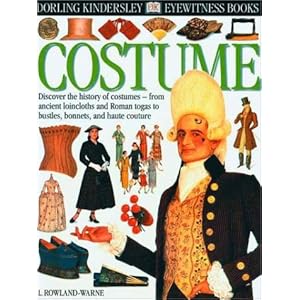
Eyewitness: Costume

Author: L. Rowland-Warne
ISBN: 0789455862
Publisher: Dorling Kindersley Children, 2000
Age: 9-12
Genre: Non-fiction

Summary: A fascinating look at the history of dress and costume. It is similar to other books in this series in that it includes full color photographs of period clothing and accessories as well as brief snippets of information explaining what each item is and its significance.  Includes sections on hats, swimwear, children’s attire, bridal garb, and more.  

Read A-likes: Eyewitness: Knights; Eyewitness: American Revolution; Eyewitness: World War II; and Eyewitness: Medieval Life.

Personal Thoughts: A fun look at dress and costume from beginning of time up to more recent times.  There are a lot of pictures of real preserved pieces of clothing from history, as well as reproductions. This book is very much like a mini museum in the pages of a book.   It’s browsability is amazing and the pictures on the cover draw a reader in to see more.

Mayflower 1620: A New Look at a Pilgrim Voyage

Author: Catherine O’Neill Grace
ISBN: 0792261429
Publisher: National Geographic, 2003
Age: 9-12
Genre: Non-fiction

Summary: This fresh account of the voyage of the Mayflower is illustrated with photographs taken on a 2001 cruise of the Mayflower II.  The story of the Mayflower, her crew, and passengers is presented in a brief and accurate portrayal of the difficulties of life at sea.  The author illustrates the planning, preparation and skills that went into a voyage during the 1600’s, and discusses the difficulties that arose, or more than likely did arise, between so many people of differing backgrounds and beliefs.  

Read A-likes: 1621: A New Look at Thanksgiving; Sarah Morton’s Day: A Day in the Life of a Pilgrim Girl; and Tapenum’s Day: A Wampanoag Indian Boy in Pilgrim Times.

Personal Thoughts: This book was a brief and yet well presented fresh look at the voyage that began the settling of a nation.  It was interesting to get a different view on a familiar story in history.  The real-life photographs included made it feel much more real and recent rather than something that simply happened in the past. 

The Remarkable Benjamin Franklin

Author: Cheryl Harness
ISBN: 0792278828
Publisher: National Geographic, 2005
Age: 4-10
Genre: Non-fiction

Summary: Benjamin Franklin was the youngest son of a youngest son for five generations, and because of this his father was sure he was special.  His father’s intention was for Benjamin to become a preacher, but finances prevented his further formal education.  Young Ben was a lover of the water and an avid learner, something that never changed.  He was apprenticed to his uncle, a printer, and he spent his spare time reading.  This is where young Ben discovered the freedom of speech, and set the course for his future. 

Read A-likes: George Washington; Thomas Jefferson; Revolutionary John Adams; and Abe Lincoln Goes to Washington: 1837-1865.

Personal Thoughts: This book is a fascinating and marvelously done glimpse into the life of one of our country’s founding fathers.  The illustrations are very engaging, and included on each page is a well known quote from Benjamin Franklin.  A fun and interesting way for kids to read a biography.

Sunday, November 7, 2010

Teens/Tweens and Researching...

Something that’s been on my mind this week is teens/tweens and their research abilities.  As I’ve been working on my e-portfolio I decided to use a paper that I had written for a LIB244 about whether or not teens have online researching skills.  One of the articles I used in this paper pointed out that most teens, when given an assignment requiring research, would immediately either Google or Wikipedia the topic rather than put any effort into looking elsewhere.  Now most people in the world would simply shrug their shoulders and wonder what’s wrong with this scenario.  On an adult level I would probably say nothing.  I use Google nearly every day myself for one thing or another, but when it comes to research, I usually only use it as a jumping off point, if even then.  The problem with tween/teens using this as a first and only resource is that the information retrieved is not always correct, useful or reliable.  Most people believe that because tweens/teens are so exposed to technology, and their usage of it is so high that means they must know how to use it to retrieve anything.  As I stated in my paper, “Constant exposure to technology does not necessarily denote advanced knowledge and understanding, simply maneuverability.”  The problem stated and suggestions made in both the articles and paper is training.  Teaching tweens/teens not only how to research, but how to determine the usefulness or efficacy of the information they are retrieving is paramount.  Most, not all, teachers assign research projects, papers, etc and simply expect students to competently research and write an intelligent and useful reply.  Now from what I’ve experienced and from what I’ve seen with my younger siblings and nieces and nephews, there isn’t a lot of instructing taking place on online researching.  How do the teachers expect their students to automatically know the whys, where’s, and how’s of research without any instruction?  I suppose what I’m getting at is that so many of the tweens and teens entering our library doors are horribly unprepared to do any but the most basic research, and it frequently falls upon us, as librarians, to teach them how to find and disseminate useful information.  My next question is…how do we do that?  (To be addressed in next posting…)

Watkins, K. (2008). Return of the Google game.  School Library Journal, p 46-48. http://www.schoollibraryjournal.com/article/CA6555545.html